Tell us about the job
Takes about a minute. No obligation.
Homes in Catahoula Parish, LA run heat about five months a year, from November through March. By the time a furnace breaks down mid-season, the burner assembly and ignition system have already been cycling for weeks. A contractor looking at a failed igniter or a cracked heat exchanger is not just pricing a part; they are pricing a part that has been working hard since the first cold snap. That context changes what they recommend: a borderline heat exchanger that might last through a short season is a liability through one this long, and a contractor who spots it will say so before closing the job.
Furnaces in older housing stock reach a point where the repair itself is straightforward but the parts are not. Half the homes in Catahoula Parish, Louisiana were built in 1980 or earlier (2020-2024 ACS 5-year). Stock built in that era ran on equipment whose manufacturers have since changed product lines, retooled, or exited the market entirely. When a contractor opens a furnace here and identifies the failed component, the next question is whether that part is still in production or has to be sourced from remaining supply. That answer changes the bill, the timeline, and sometimes whether the repair is the right path at all.
The Parts of a Furnace a Contractor Checks First
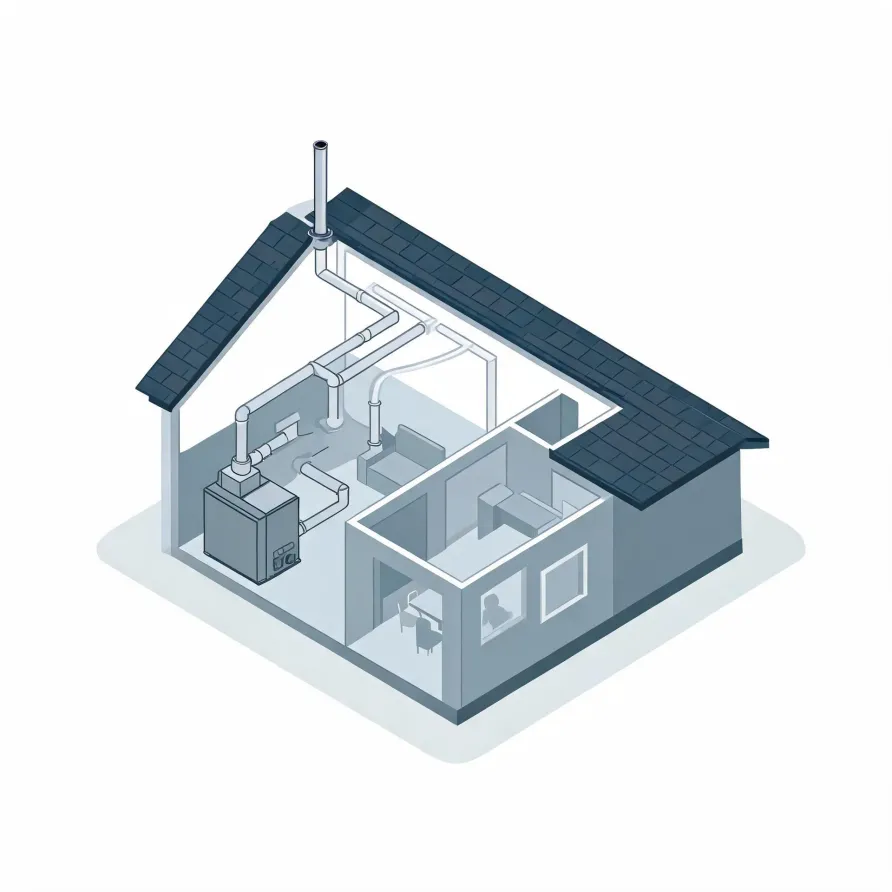
The furnace cabinet sits in a utility room, basement, or closet and holds most of what a contractor examines. Inside it, the heat exchanger is the piece that takes the most wear. A cracked exchanger lets combustion gases into the living space, so it draws attention early. The burners, which sit just below it, are checked next when heat output has dropped or ignition is unreliable.
The blower motor pushes conditioned air into the supply side of the duct system and sits at the base of the cabinet. The draft inducer, mounted at the top near the flue connection, pulls exhaust out of the heat exchanger. The igniter and flame sensor work as a pair near the burner assembly, and either one can stop a furnace from firing without triggering an obvious failure elsewhere.
The drawing shows a typical furnace layout, and a licensed contractor determines which components apply to the specific system in your home.
Get matched in Catahoula ParishCatahoula Parish by the Numbers
74 severe weather events were recorded in Catahoula Parish, Louisiana between 2015 and 2024.
NOAA National Centers for Environmental Information, Storm Events Database, bulk CSV export, events 2015-01-01 through 2024-12-31.Half the homes in Catahoula Parish, Louisiana were built in 1980 or earlier (2020-2024 ACS 5-year).
U.S. Census Bureau, 2020-2024 American Community Survey 5-Year EstimatesCatahoula Parish, Louisiana holds 4,470 housing units (2020-2024 ACS 5-year).
U.S. Census Bureau, 2020-2024 American Community Survey 5-Year EstimatesOwners occupy 78.0% of the occupied homes in Catahoula Parish, Louisiana (2020-2024 ACS 5-year).
U.S. Census Bureau, 2020-2024 American Community Survey 5-Year EstimatesCodes & Standards Behind Furnace Repair in Catahoula Parish, Louisiana5 sourced rules & standards
What HVAC Repair Looks Like in Catahoula Parish
Non-weatherized gas furnaces manufactured on or after November 19, 2015 must reach 80.0 percent AFUE.
Non-weatherized oil-fired furnaces manufactured on or after November 19, 2015 must reach 83.0 percent AFUE.
Mobile home gas furnaces manufactured on or after November 19, 2015 must reach 80.0 percent AFUE.
Non-weatherized gas furnaces manufactured on or after December 18, 2028 must reach 95.0 percent AFUE, up from the 80.0 percent minimum that applies to units manufactured before that date.
Licensing Rules for HVAC Repair in Catahoula Parish, Louisiana
Louisiana requires an active state contractor licence: it is unlawful to engage or continue in the business of contracting, or to act as a contractor, without one.
Severe Weather Events in Catahoula Parish
Extreme weather puts real hours on a furnace. The more a system is pushed hard to compensate for outside conditions, the more likely it is to need attention, and that pattern is specific to where you live.
74 severe weather events, 2015–2024. Source: NOAA National Centers for Environmental Information, Storm Events Database.