Tell us about the job
Takes about a minute. No obligation.
A furnace repair in Claiborne Parish starts at the burner and ignition system, because those are the parts that cycle every time the equipment runs. Homes in Claiborne Parish, LA run heat about five months a year, from November through March. Each cycle stresses the igniter, the heat exchanger, and the flame sensor in ways that compound quietly across a full season. By the time a homeowner notices something wrong, a contractor pulling the panels will find wear that has been building since November. That wear tells the story of how the system was loaded and whether the parts still have a reliable season left in them.
Ductwork in a house this old was fitted for systems that no longer exist, and the furnace running in it today is almost certainly not the original one. When a contractor opens the unit, what they find determines whether the repair is straightforward or whether the parts it takes are still in production. Half the homes in Claiborne Parish, Louisiana were built in 1974 or earlier (2020-2024 ACS 5-year). That gap between when the house was built and what it now contains is where furnace repair in this parish gets complicated: a part that looks standard on the outside may draw from a supply chain that has narrowed considerably, and a contractor has to know what they are actually holding before they can price or source anything.
The Parts of a Furnace a Contractor Checks First
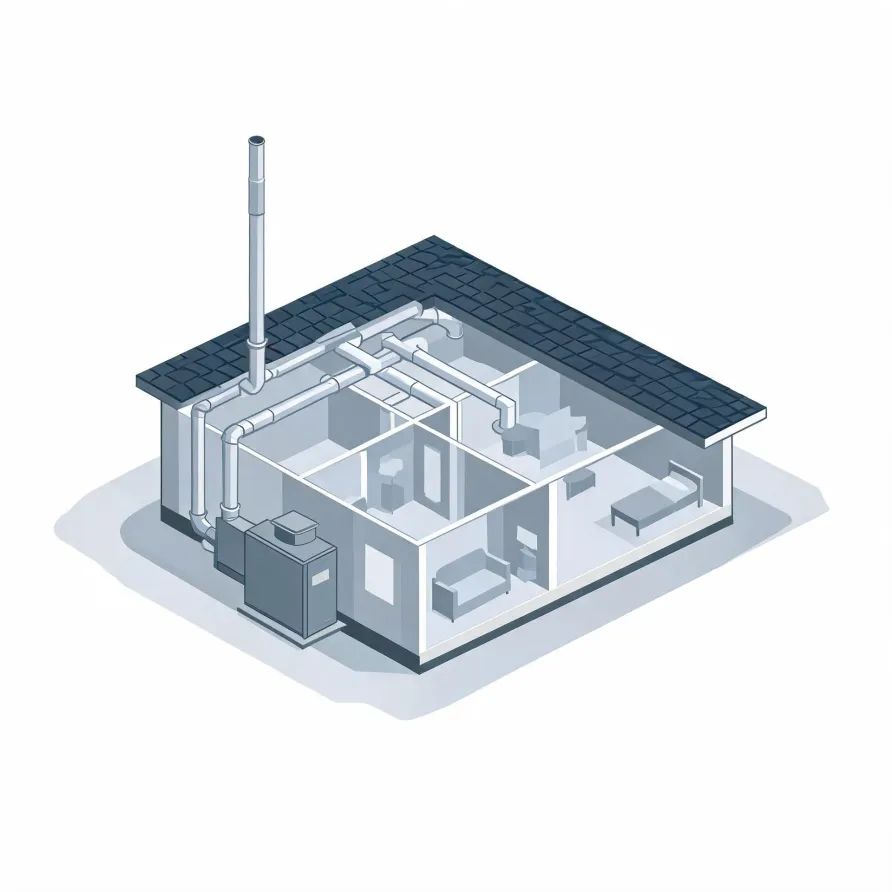
The heat exchanger sits at the core of the furnace cabinet and is the piece a contractor looks at closely when something smells wrong or heat output drops. The burner assembly sits just below it, and a cracked exchanger or a dirty burner is often where a heating problem begins. The ignitor and flame sensor are small components in that same compartment, and either one can stop the furnace from lighting.
The blower motor and its wheel sit in the lower half of the cabinet and push conditioned air out through the supply plenum. The control board runs the whole sequence from call-for-heat to shutdown, and when the furnace behaves erratically or shuts off mid-cycle, that board is where a contractor looks next. The flue pipe exits the cabinet at the top or rear and carries combustion gases out of the house.
The drawing shows the general layout of a furnace system, and a licensed contractor determines which components apply in your particular home.
Get matched in Claiborne ParishClaiborne Parish by the Numbers
64 severe weather events were recorded in Claiborne Parish, Louisiana between 2015 and 2024.
NOAA National Centers for Environmental Information, Storm Events Database, bulk CSV export, events 2015-01-01 through 2024-12-31.Half the homes in Claiborne Parish, Louisiana were built in 1974 or earlier (2020-2024 ACS 5-year).
U.S. Census Bureau, 2020-2024 American Community Survey 5-Year EstimatesClaiborne Parish, Louisiana holds 6,810 housing units (2020-2024 ACS 5-year).
U.S. Census Bureau, 2020-2024 American Community Survey 5-Year EstimatesOwners occupy 68.8% of the occupied homes in Claiborne Parish, Louisiana (2020-2024 ACS 5-year).
U.S. Census Bureau, 2020-2024 American Community Survey 5-Year EstimatesFurnace Repair Rules & Standards on Record for Claiborne Parish, Louisiana5 sourced regulations and standards
What the repair visit looks like
Non-weatherized gas furnaces manufactured on or after November 19, 2015 must reach 80.0 percent AFUE.
Non-weatherized oil-fired furnaces manufactured on or after November 19, 2015 must reach 83.0 percent AFUE.
Mobile home gas furnaces manufactured on or after November 19, 2015 must reach 80.0 percent AFUE.
Non-weatherized gas furnaces manufactured on or after December 18, 2028 must reach 95.0 percent AFUE, up from the 80.0 percent minimum that applies to units manufactured before that date.
Licensing Rules for HVAC Repair in Claiborne Parish, Louisiana
Louisiana requires an active state contractor licence: it is unlawful to engage or continue in the business of contracting, or to act as a contractor, without one.
Severe Weather Events in Claiborne Parish
Weather in Claiborne Parish puts real demands on heating equipment: hard swings in outdoor conditions force furnaces to cycle harder and more often than in moderate climates. That workload accumulates, and repair needs here reflect local conditions rather than any national average.
64 severe weather events, 2015–2024. Source: NOAA National Centers for Environmental Information, Storm Events Database.