Tell us about the job
Takes about a minute. No obligation.
A repair contractor working a St. Tammany Parish furnace starts with the burner assembly and the ignition system, because those are the parts that have been cycling the hardest. Homes in St. Tammany Parish, LA run heat about five months a year, from November through March. Each startup and shutdown stresses the igniter, the heat exchanger, and the flame sensor in ways that add up across a season. By the time a furnace stops lighting reliably, the igniter and flame sensor are the first things a contractor pulls and inspects, not because they are the cheapest fix, but because the load falls squarely on them.
Half the homes in St. Tammany Parish, Louisiana were built in 1995 or earlier (2020-2024 ACS 5-year). For a furnace repair in stock this age, what a contractor finds once the heat exchanger or burner assembly is open shapes everything that follows. Worn components in systems running in houses built around them can require parts that manufacturers have phased out, and a contractor has to confirm availability before the repair scope can be set. That search happens at the parts level, inside the unit, not at the curb.
The Parts of a Furnace a Contractor Checks First
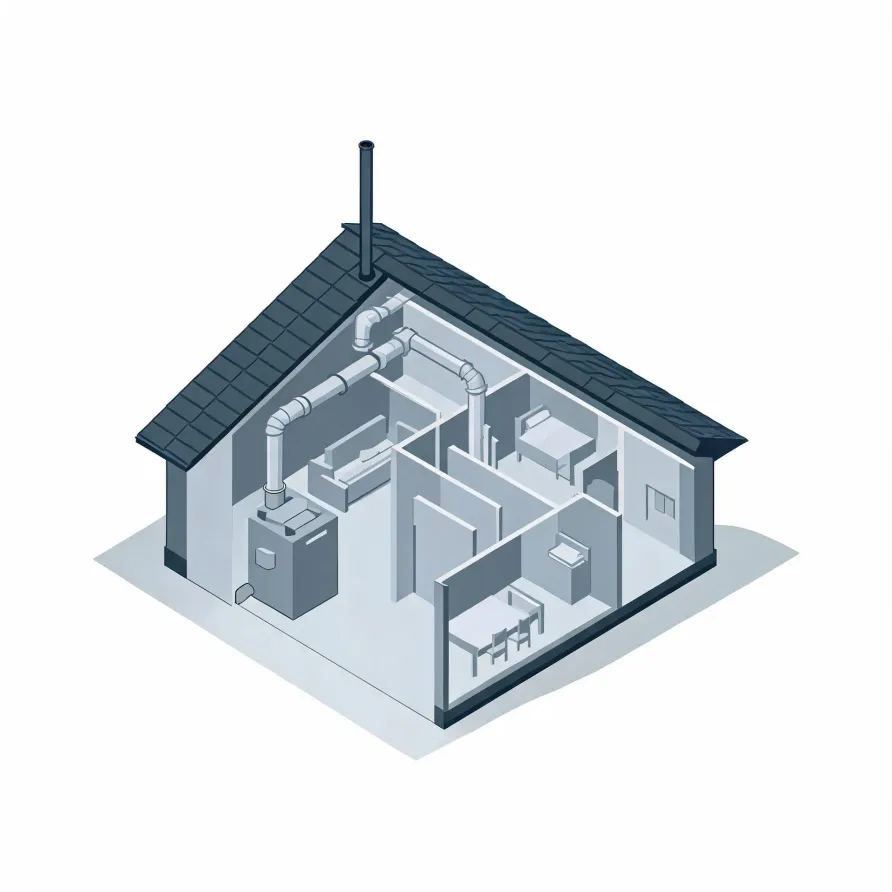
The heat exchanger sits at the core of the furnace cabinet in your utility space, basement, or closet, and it is the piece that transfers heat to the air moving through your home. When it cracks or corrodes, you lose heat output and can get combustion gases into the living space. The burner assembly sits just below it, and a failed igniter, dirty burner port, or faulty flame sensor there is often where a repair call starts.
The blower motor and its fan wheel sit in the lower section of the cabinet and push conditioned air out through the supply side of your duct system. The flue or vent pipe runs from the top or back of the cabinet to the outside, and a contractor checks it for blockages or separation. The control board ties all of it together and is where a technician reads fault codes to trace a problem back to its source.
The drawing shows a typical furnace layout, and a licensed contractor determines which components apply to the specific system and installation in your home.
Get matched in St. Tammany ParishSt. Tammany Parish, by the numbers
146 severe weather events were recorded in St. Tammany Parish, Louisiana between 2015 and 2024.
NOAA National Centers for Environmental Information, Storm Events Database, bulk CSV export, events 2015-01-01 through 2024-12-31.Half the homes in St. Tammany Parish, Louisiana were built in 1995 or earlier (2020-2024 ACS 5-year).
U.S. Census Bureau, 2020-2024 American Community Survey 5-Year EstimatesSt. Tammany Parish, Louisiana holds 113,911 housing units (2020-2024 ACS 5-year).
U.S. Census Bureau, 2020-2024 American Community Survey 5-Year EstimatesOwners occupy 78.9% of the occupied homes in St. Tammany Parish, Louisiana (2020-2024 ACS 5-year).
U.S. Census Bureau, 2020-2024 American Community Survey 5-Year EstimatesCodes & Standards Behind Furnace Repair in St. Tammany Parish, Louisiana5 sourced rules and standards
What Happens When a Contractor Comes Out
Non-weatherized gas furnaces manufactured on or after November 19, 2015 must reach 80.0 percent AFUE.
Non-weatherized oil-fired furnaces manufactured on or after November 19, 2015 must reach 83.0 percent AFUE.
Mobile home gas furnaces manufactured on or after November 19, 2015 must reach 80.0 percent AFUE.
Non-weatherized gas furnaces manufactured on or after December 18, 2028 must reach 95.0 percent AFUE, up from the 80.0 percent minimum that applies to units manufactured before that date.
Licensing and Legal Requirements in St. Tammany Parish, Louisiana
Louisiana requires an active state contractor licence: it is unlawful to engage or continue in the business of contracting, or to act as a contractor, without one.
Severe Weather Events in St. Tammany Parish
Extreme weather puts real stress on furnace components, and St. Tammany Parish has its own pattern of conditions that shape how hard local equipment has to work. A furnace that runs through weather swings takes on wear that a mild-climate unit never sees, which is why local repair work starts with understanding what the climate actually demands.
146 severe weather events, 2015–2024. Source: NOAA National Centers for Environmental Information, Storm Events Database.